
How to Create a Content
1. Overview / What Is Module Deployment?
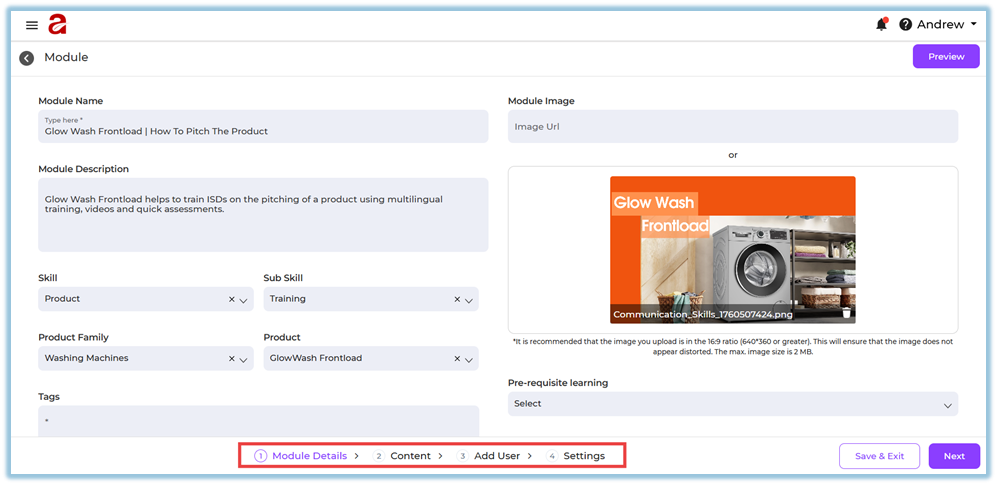
Module Deployment is the complete process of creating and launching a learning module in Converse.
It consists of four core steps:steps while deploying a module:
- Module Details → Define all metadata
- Content → Build the training structure and upload learning materials
- Add Users → Select the learners who will receive the module
- Settings & Publish → Configure notifications and launch the module
https://help.bsharpcorp.com/books/features/page/content
This feature enables admins and content creators to build structured learning journeys, enforceconfigure completion rules, targetdeploy to the righttarget users, and publish training modules with the appropriate notifications and reminders.
What problem does this solve?
Organizations need a scalable way to:
- Create structured training content
- Target specific users or teams
- Track completion and compliance
- Maintain consistent, high-quality learning formats
- Deliver training using multiple channels (in-app, email, WhatsApp, Google Chat)
Simple example:
A company wants to launch a “Cybersecurity Awareness Training”.Converse enables the admin to:
Set module details → categorize under Skills, Sub-skillsUpload PDF, Video, Quiz → lock sequential pagesAssign to “All India → Sales Department”Send reminders and publish
All in a guided, step-by-step process.
2. When and Why to Use This?Use?
Use the module deployment process when you need to:
LaunchTrainayourstructuredteamtrainingonprogramlatest products, updates, compliance and other contentsUploadConvertlearning materials such asyour PDF, video, quiz, text as a learning modulesEnforceSet completion rules (mandatory pages, minimum view time) to ensure the content is being consumed as you desire- Roll out training to selected teams or regions
- Run compliance, onboarding, product training, or certification programs
- Track completion and engagement reports
Who should use this?
Admins→ Responsible for setting up metadata and assigning usersContent creators / L&D→ Upload content, design learning flowHR / Compliance teams→ Assign mandatory or policy trainingSales / Service trainers→ Deploy product and skill-based training
“Is this for you?” checklist:
Use this feature if:
You want a structured module instead of ad-hoc filesYou need to track completionYou want sequential learning (locks)You want to reach specific target groupsYou want automated remindersYou want reporting at module, page, or quiz level
3. Key Concepts / Terminology
Module
A complete learning unit consisting of sections, pages, and content.
Section
Top-level grouping inside a module (e.g., Intro,Introduction CoreAgenda, Offering,Product Features, Objection handling and Summary).
Page
A learning block within a section containing content items.items (multiple document formats).
Content Item (Card)
Individual learning material:
Text, Image, PDF, Video, Quiz, LearnBee content, SCORM.
Skill / Sub-skill
Product Family / Product
Mapping used for product-based learning setups.
Mandatory Page
Learners must complete this to finish the module.
Lock Page
Learners must complete the previous page before unlocking the next.
Minimum ViewViewing Time
Timer on PDFs/videos that ensures enough viewing is done.
Attribute Group
Automatically assigns modules based on user properties (country, department, etc.).
Assigned Notification
Message sent when a module goes live.
Reminder Alert
Follow-up messages sent only to users who haven’t completed training.
4. HowProduct toset Setup It Up / Configure Itguide
The deployment process is divided into four guided steps.
- Module Details
- Content
- Assign Users
- Settings
STEP 1 — MODULE DETAILS
(Define metadata and classification)
Setup Steps
- Enter module name and description
- Choose Skill and Sub-skill
- Select Product Family & Product
- Add Tags (optional)
- Choose Module Type (Training, Policy, Certification, etc.)
- Select Importance (High/Medium/Low)
- Select Language
- Enter Duration
- Upload Thumbnail image
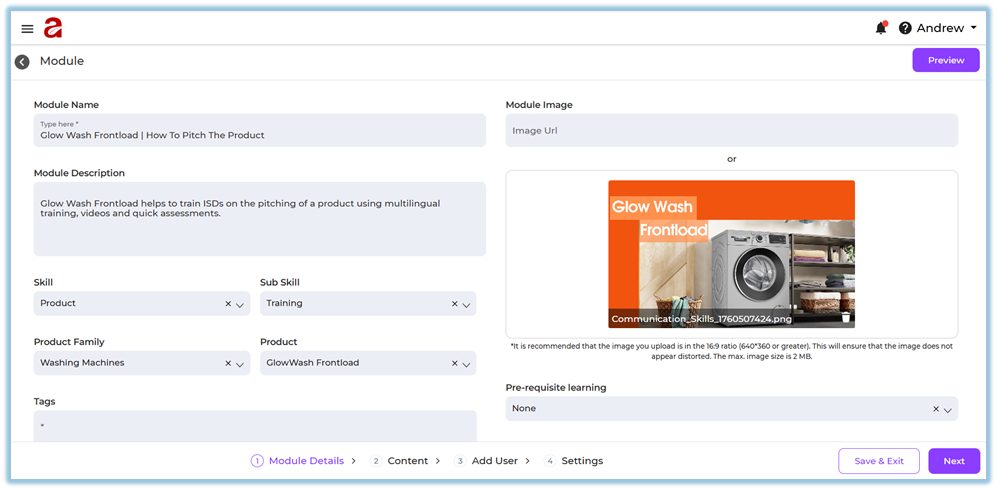
- Set Pre-requisite Module
A pre-requisite module is a module the learner must complete first before starting the current module.
This ensures the learner follows the correct learning order.
Only one module can be added as a pre-requisite module.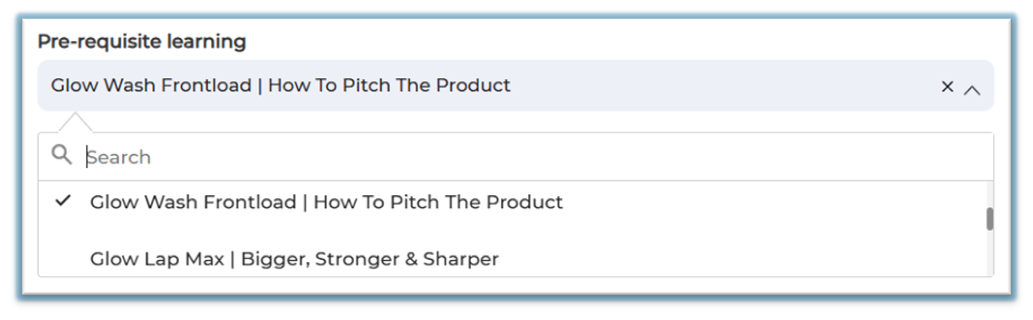
Example:
If there are two modules:-
Module – Part 1
-
Module – Part 2
Here, Part 1 is the pre-requisite module for Part 2.
When a learner opens Part 2, the system will ask them to complete Part 1 first.
This is because Part 1 contains the basic information needed before moving to Part 2. -
- Set Equivalence Module
An equivalence course is another module that teaches the same learning content.
If two modules are equivalent, completing either one will count as completing both.
Only one module can be added as a Equivalence module.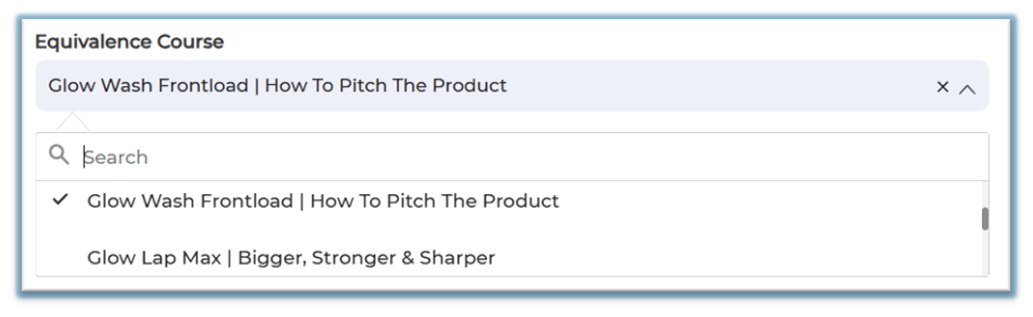
Example:
If you have:- Module A – Glow Air Fryer Overview (PDF)
- Module B – Glow Air Fryer Overview (Video)
You can set Module B as the equivalent of Module A.
This means:
- If the learner completes the video, the PDF version also shows as completed.
- And if they complete the PDF, the video version will also be marked completed.
➡ All configuration options referenced here come from admin settings pages.
(Example: Skills, Languages, Product Families, and Module Types)
Do’s
- Match skills/products accurately for reporting
- Keep names clear (“Product X – Service Basics”)
- Use the right module type
Don’ts
- Avoid long titles
- Don’t skip mapping skills—affects analytics
STEP 2 — CONTENT
(Build the actual training journey)
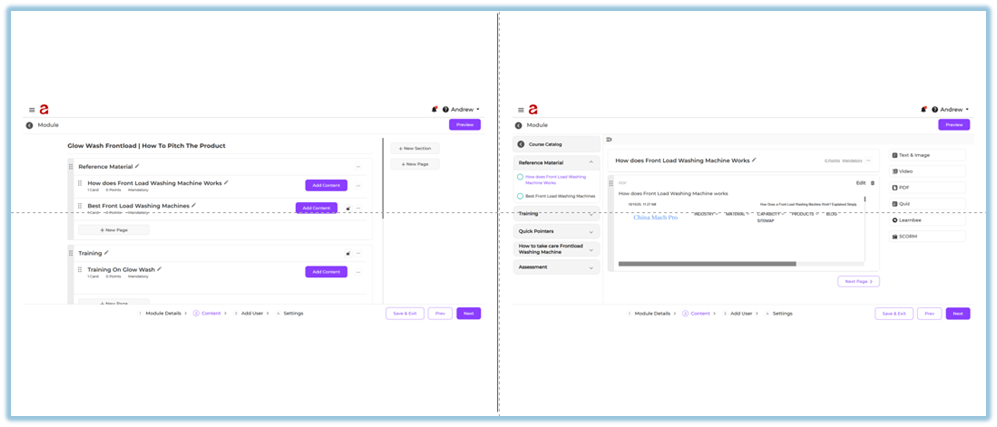
Structure Overview
A module → contains Sections → each containssection can have multiple Pages → each holdspage can have multiple Content Items.
Setup Steps
- Create Sections (Intro, Core Concept, Summary)
- Create Pages inside each section
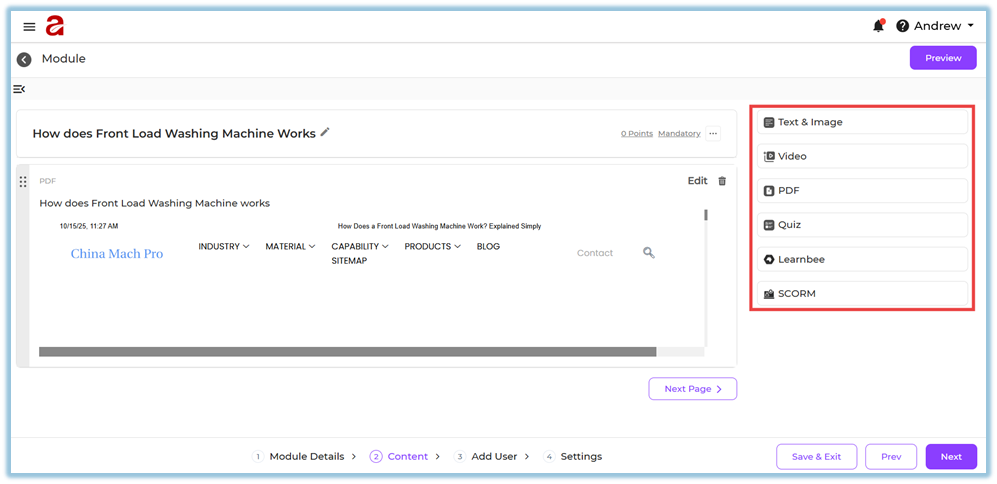
- Add content items:
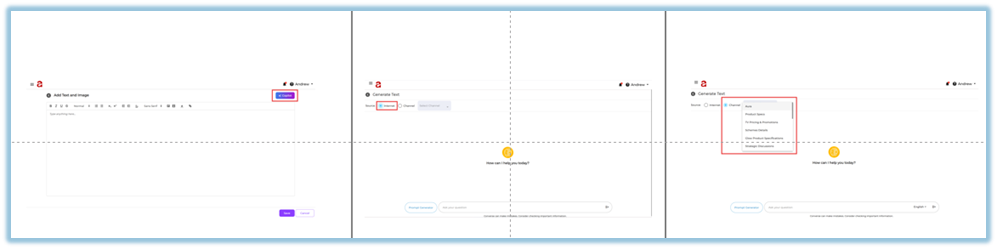
- Text & Image (editor + Co-Pilot AI)
Using Co-PilotYou can generate content using AI with two sources:Internet→ pulls publicly available informationChannel→ uses only your internal knowledge base
- PDF (with download control + minimum view time)
- Video (upload or YouTube link)
- Quiz (single/multi-select, shuffle)
- LearnBee
content - SCORM
packages
- Reorder content by dragging
4.Reorder content by dragging
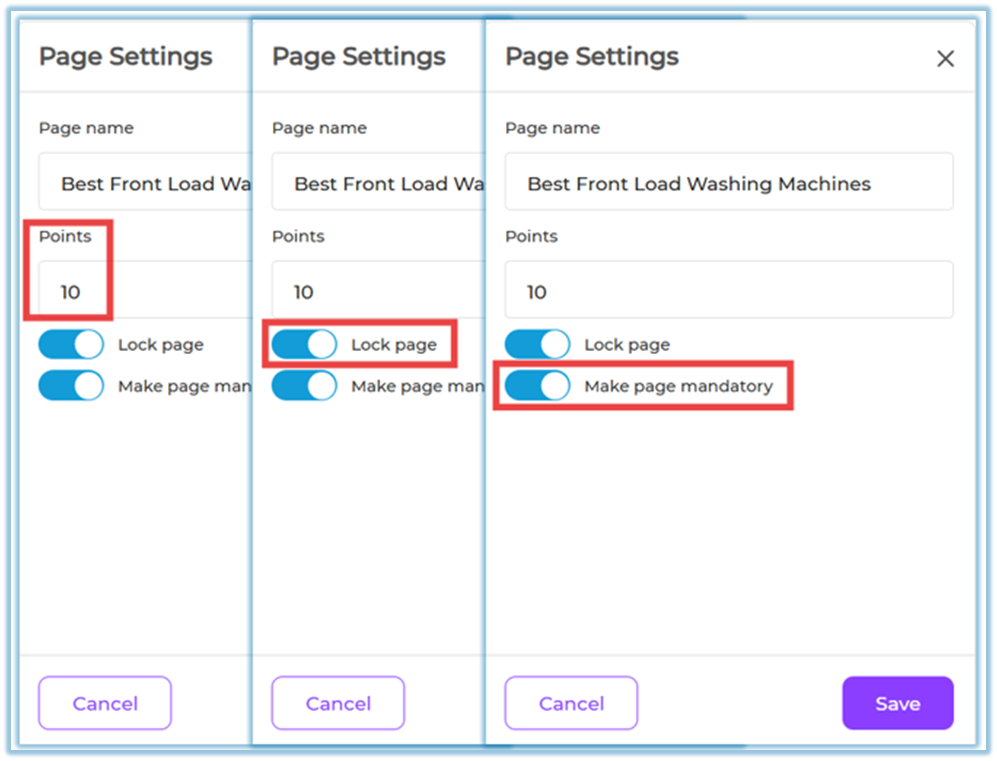
5. Configure Page settings:
-
- Mandatory
- Lock
- Points
Do’s
- Use multiple Pages for clarity
- Keep content bite-sized
- Use locks for sequential learning
- Use minimum view time only when required
Don’ts
- Avoid overloading one page
- Avoid unnecessary locks
- Avoid long videos (compress instead)
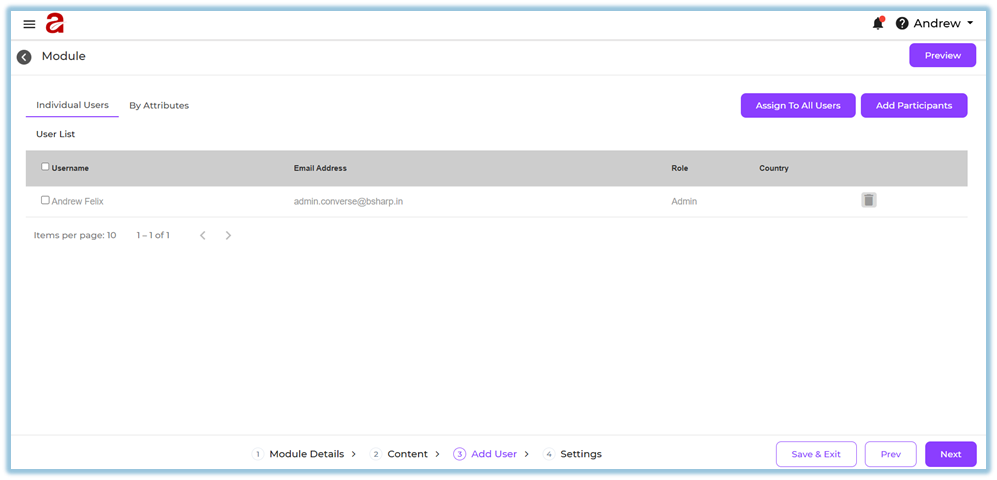
STEP 3 — ADD USERS
(Choose who should receive the module)
You can assign modules using three methods:
1. Individual Assignment
Pick specific users manually.
2. Assign to All Users
Visible to everyone who has ever logged in.
3. Attribute Assignment (Dynamic)
Create an attribute group such as:
- Country = India
- State = Karnataka
- City = Bangalore
OR - Department = Sales
- Role = Manager
Newly joined users who match attributes are automatically assigned.
Setup Steps
- Go to Add Users
- Select method (Individual / All / Attributes)
- For attributes → create group rules
- Save
- Review user count
Do’s
Use attributes for large or dynamic teamsUse Individual for pilot batchesUse Assign to All for mandatory org-wide training
Don’ts
Avoid over-narrow attribute rulesAvoid Assign to All for targeted training
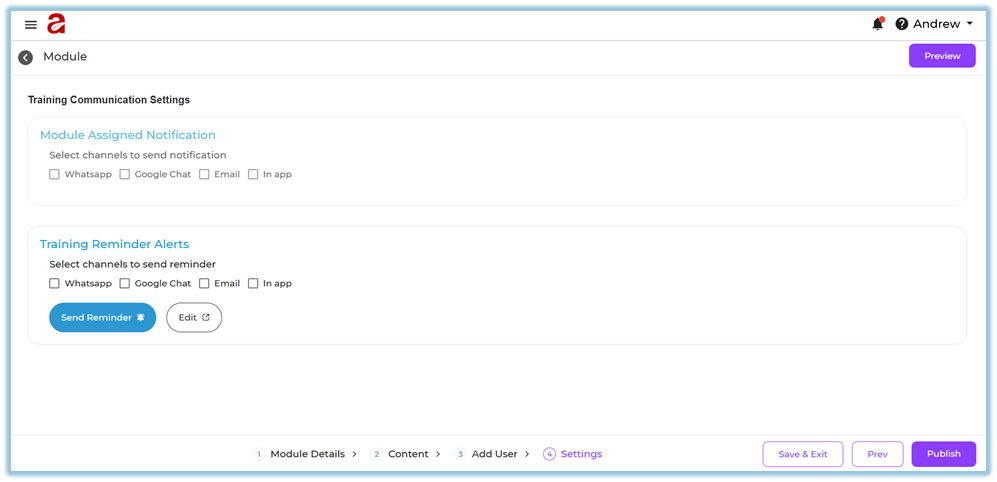
STEP 4 — SETTINGS & PUBLISH
(Configure notifications & launch training)
Setup Steps
- Choose channels for Assigned Notification:
WhatsApp, Google Chat, Email, In-App - Enable Reminder Alerts for incomplete users
- If needed, send Manual Reminder
- Preview module
- Click Publish
System Behavior
- Notification goes out immediately after publish
- Reminders go only to incomplete learners
- Cannot unpublish a module
- Use versioning if changes are required
Do’s
- Use multiple channels for critical modules
- Preview before publishing
Don’ts
- Don’t publish without checking assignments
- Don’t rely on WhatsApp without integration setup
5. How It Appears to the End User
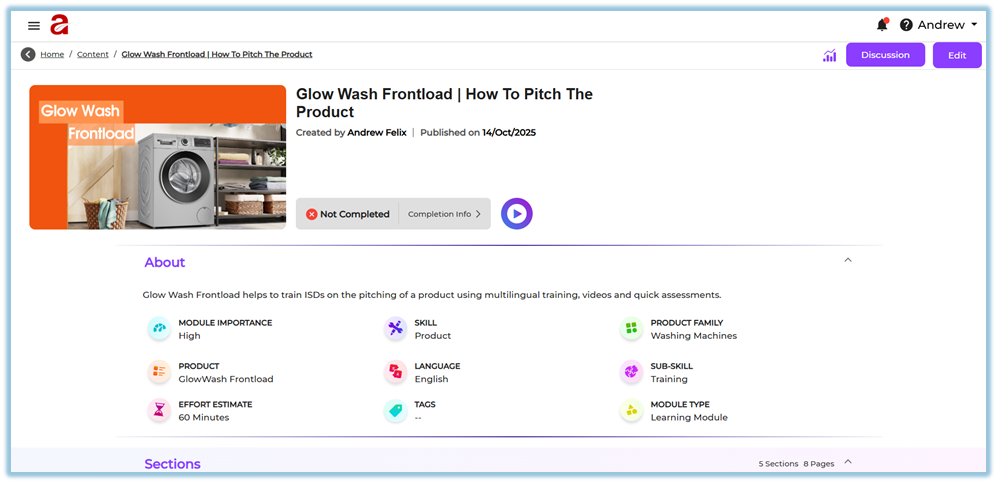
Module Details
Learners see:
- Title
- Description
- Duration
- Thumbnail
- Language
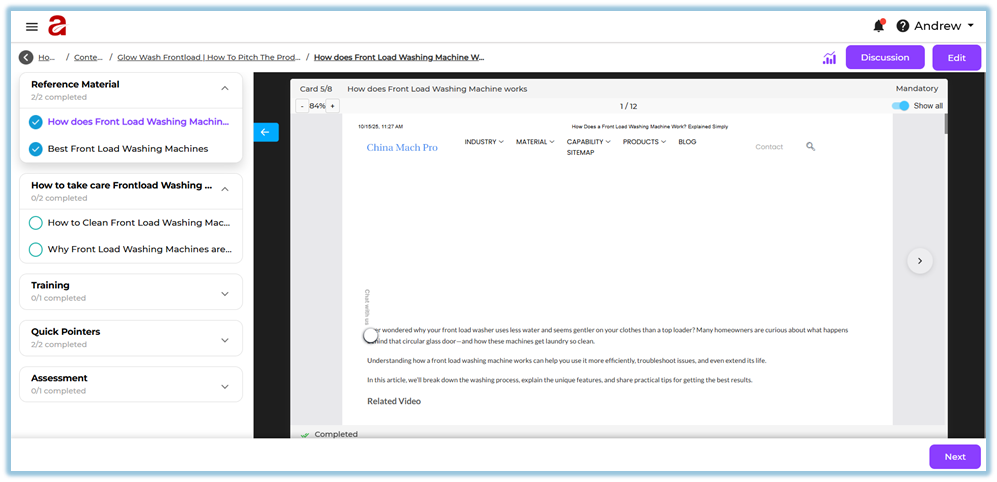
Content Experience
Learners see:
- Section and Page names
- Cards in sequence
- Locked or mandatory indicators
- Minimum view time prompts
Assignment
Learners see the module in their Learning Hub once published.
Notifications
Sent on selected channels with module title and link.
Reminders
Appear only if learners haven’t completed the module.
6. How to Track / Report
Reports show:
Module-level
- Total assigned
- Completed
- Pending
- Not started
- Average time spent
Page-level
- Page completion
- Locked/unlocked status
- Minimum view time completion
Content-level
- Quiz scores
- Document views
- Video completion
Filters
- Skill
- Product
- Region
- Designation
- Attribute-based groups
For deeper analysis, cross-link to Reporting pages inside your helpdesk.
7. Best Practices & Expert Tips
Structuring Content
- Use 3–5 sections maximum
- Keep pages short and focused
- Add quizzes after heavy content
Assignment Strategy
- Use attributes for large and growing teams
- Use Individual only for pilots
Engagement Strategy
- Use 2 reminder channels minimum
- Send manual reminders before deadlines
Compliance Strategy
- Use locked pages for linear learning
- Use minimum view time sparingly
- Ensure mandatory pages are clearly marked
8. Troubleshooting / FAQs
Module not visible
Cause: Wrong assignment method
Fix: Check Individual/Attributes/Assign to All
PDF not marking complete
Cause: Minimum view time not finished
Fix: Reduce time or remove timer
Page not unlocking
Cause: Locked + mandatory content incomplete
Fix: Complete previous page fully
Reminders not sending
Cause: Reminder channels disabled
Fix: Enable channels in Settings → Reminder Alerts
Users not receiving WhatsApp notifications
Cause: Integration not configured
Fix: Check WhatsApp integration provider
Cannot publish
Cause: Missing mandatory fields
Fix: Verify Module Details and Content setup